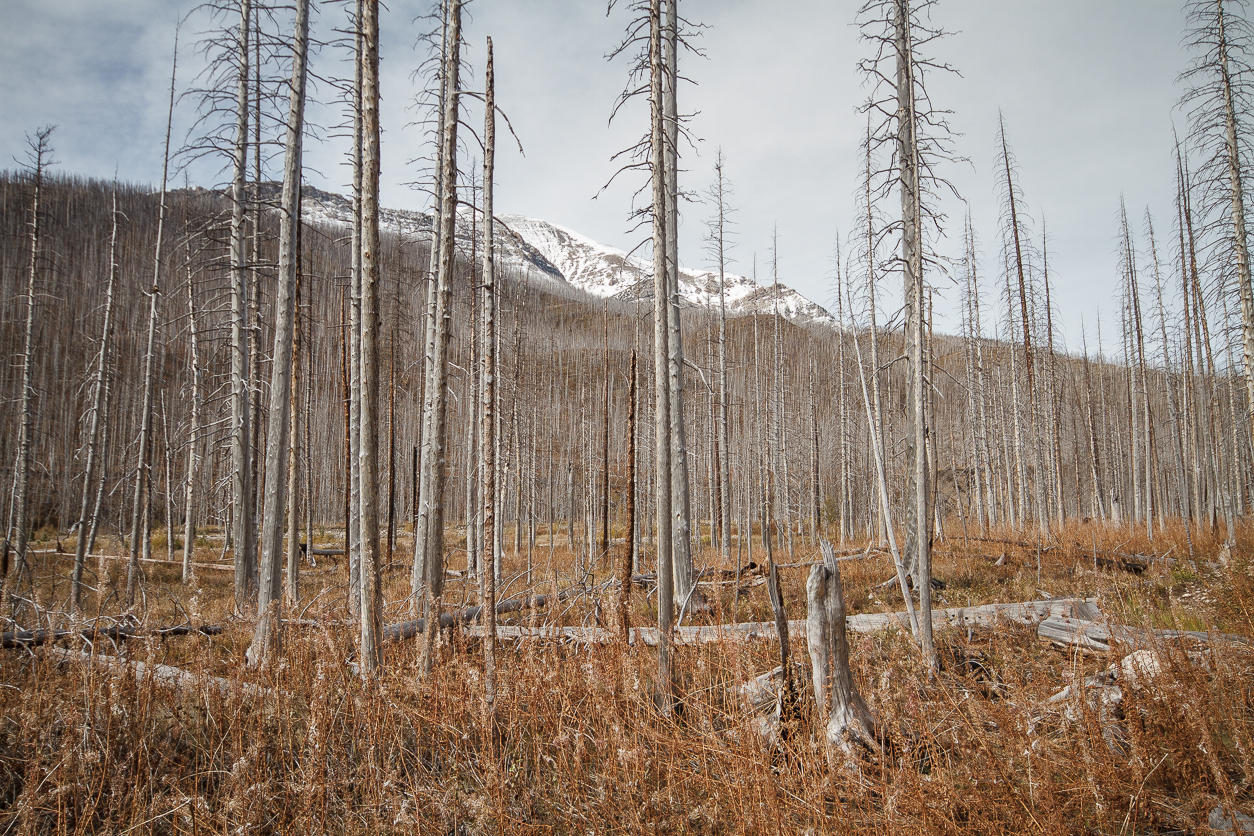
Burns, snags, and blighted places.

Recovering Forest

Amongst the outdoor crowd, these places are often avoided, whispered about as “unsightly”, and left for the animals. I don’t feel that way. Although I enjoy nothing more than verdant forest and mountain streams, there’s a certain sincerity to these fire recovery zones. This sincerity is rooted in the truth of Earth. We were born of fire and ash. This is a violent, devastating, volcanic planet.

Hikers who encounter a burn recovery zone are not witnessing an outlier, or death. What they see is a birth.

I’ll gladly spend all day amongst these silver snags, fishing, daydreaming and hiking. These recovery zones are warmer, and often you can find me basking on a rock like an albino lizard. They also make great grasshopper habitat, and thus the streams are rife with the sound of bony trout jaws smacking crunchy grasshoppers. If one is a fly-fisherman, a hopper pattern would be a good bet here.

Hikers often pass right through recovery zones, not bothering with photos. They’ll continue on to greener, non-burned forests, where they’ll pop selfies. You’ll never find these snags in their photo albums. “Too unsightly”, they’ll say. Or ugly.

But black bears don’t mind, nor various species of woodpeckers. And neither do I. If you’re ever in the mountains, and you see a lunatic lounging about one of these recovery zones, offer a friendly wave and he’ll wave back. And maybe, stick around for a bit. You may find this aesthetic the most pleasing of them all.
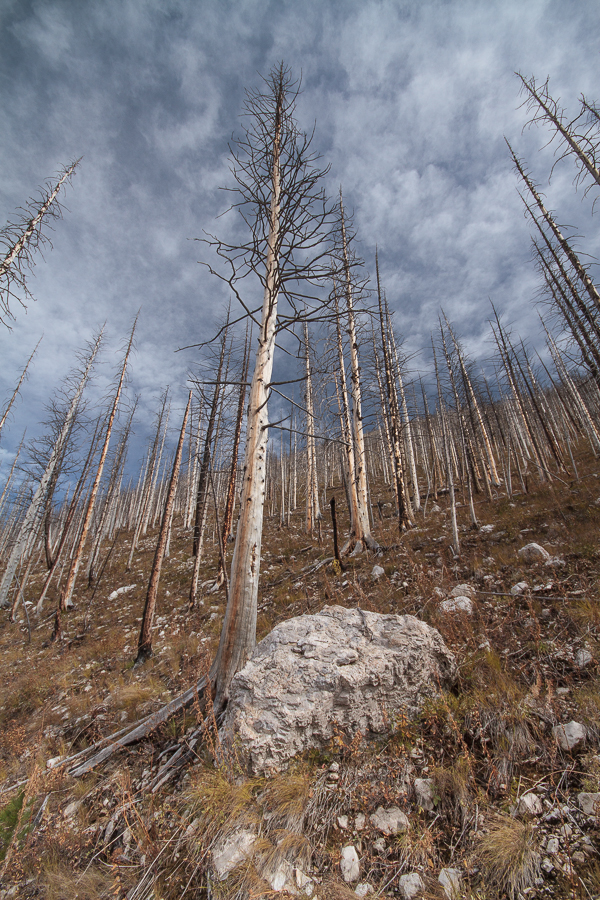
Snags

A fire recovery zone, Bob Marshall Wilderness, Montana.
The Inland Temperate Rainforest: A Museum of Now

The Inland Temperate Rainforest stretches from northwestern Montana to Idaho, and on to Washington. Very few people even know it exists. But that doesn’t make it any less special. In this unique forest you’ll find rare grizzly bears, wolverine, threatened lynx, and the endangered mountain caribou. Almost all of the flora and fauna prior to European settlement still exist here. It’s not all good news, however. This ecosystem is threatened by road-building, and the grizzly bear population is so tenuous that augmentation is required to keep it hanging on. Most of the grizzlies live high up in the Purcell-Cabinet Mountains, foraging along the steep slopes and avalanche chutes. They are remarkable creatures, requiring space free of human development. The same can be said for the wolverine.

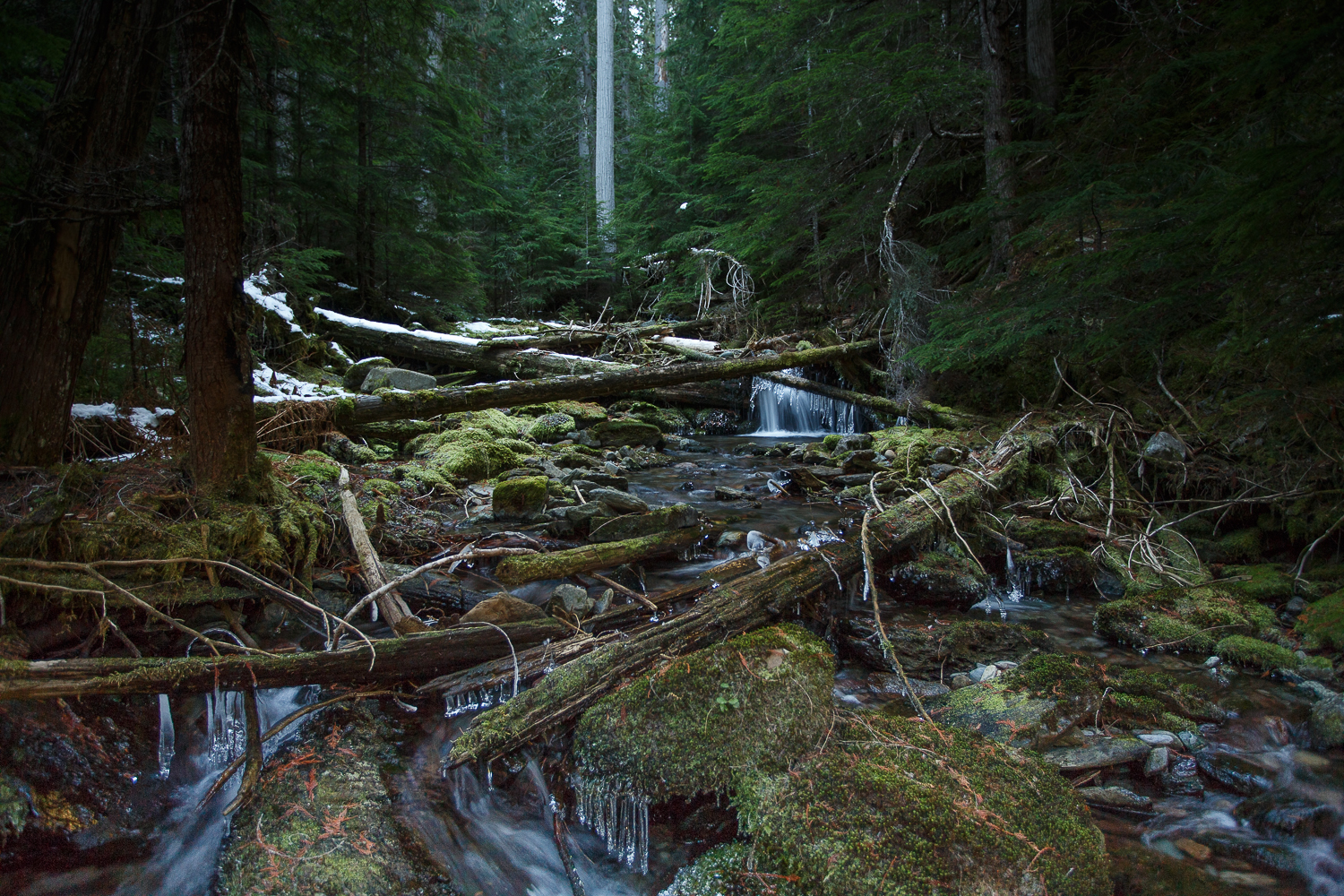
Most of the Purcell-Cabinet rainforest ecosystem is federal public land. For some, the phrase raises a big question mark (national forests and parks are a long way off for some people). For others, it elicits chills. Our National Parks and National Forests cradle the last roadless areas and in some cases protect a full array of native flora and fauna. In a way, these places are the most fascinating museums you’ll ever find.

It always puzzles me how people can spend all day inside the Field Museum of Natural History, staring at what is gone, while driving past (or not even having a basic understanding) of our living, current museums. While the value of the Field Museum of Natural History is undoubtedly high, one could make the case that our living museums are even higher. For here is a world that still exists, with creatures barely hanging on.

At this museum, you’ll feel the pinch of a mosquito rather than reading about the pinch. In this museum, the plants and trees give off oxygen. In this museum, that pair of eyes staring back at you may be powered by a functioning nervous system and a thrumming heart. In this museum, you can explain to your kids that what they are seeing is not a simulation or an app–that what stalks there lives and breathes just like they do, that there are no Dodo birds here. Not yet, anyway.

Go ahead, hop over that velvet rope barricade or slip on under. Get your shoes muddy, sweat a little. This exhibit is as real as it gets. It’s waiting for you, like it always has.

Montana-Inland-Temperate-Rainforest-creek-2-h

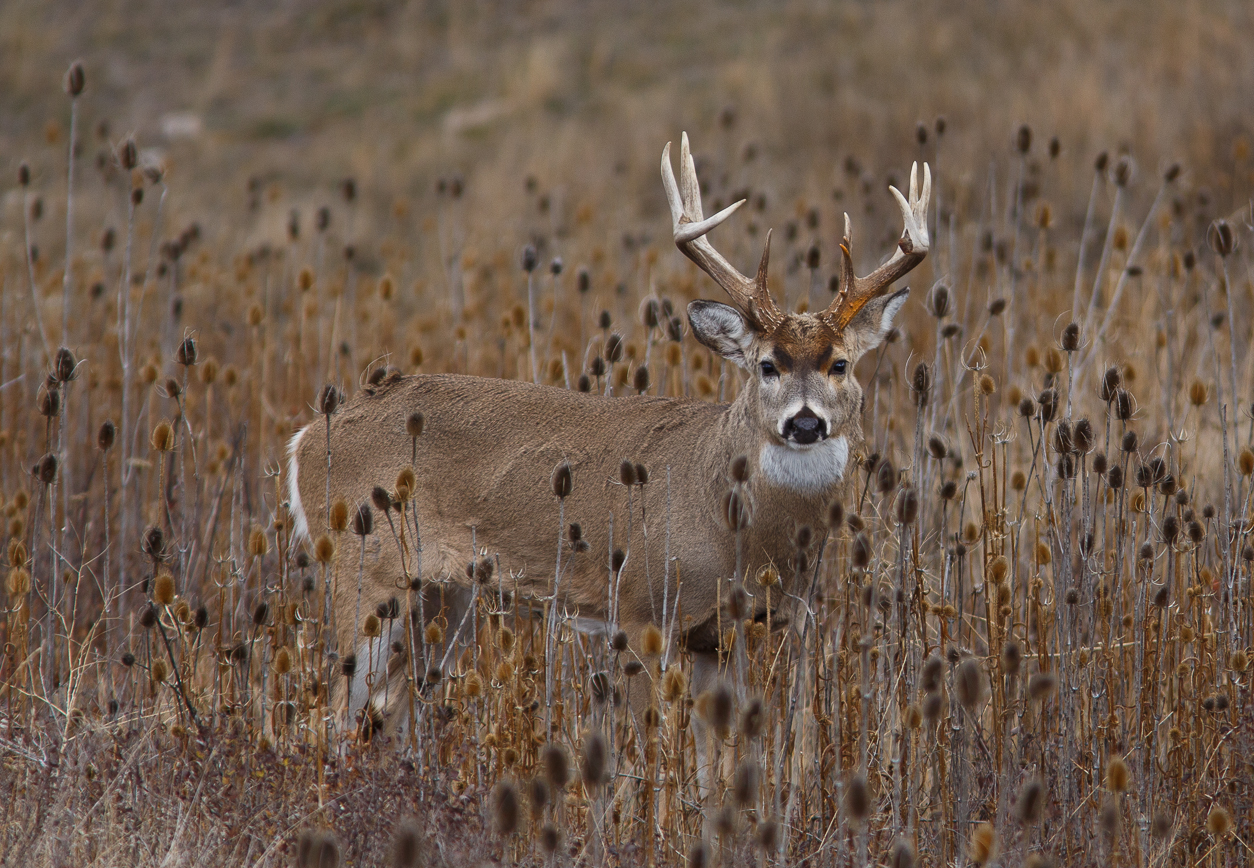
White-tailed buck

While in Montana over the fall and winter of 2013, I had the privilege of filming the white-tailed deer rut. The deer are not as cautious as usual, as they are focused on mating. I spent days with these gracious creatures, rising with the sun and leaving as it disappeared. After a while, I picked up on the deer’s rhythms, and maybe they picked up on mine.

This big buck decided to stop and pose for me in the teasel. Already I’m counting the days until I can return to the Northern Rockies. A person can still be homeless, even with a roof over their head.

Hoss-Buck

Illinois: cougar killin’ country

Illinois has done it again. They made sure to kill another rare cougar as quickly as possible.

I’m embarrassed by the Illinois DNR, certain residents, and other government institutions when it comes to self-awareness. Embarrassed at the lack of tolerance for other living things. It seems that any wild animal, be it cougar or wolf, is gunned down or gleefully peppered with arrows as soon as it crosses the border. Cougars aren’t even protected in the state despite being extirpated many years ago.

It’s true, Illinois isn’t exactly wild country. I’d say it’s the least wild state. I’d also classify it as the least scenic state. Illinois wasn’t born this way. We did it.

On November 20th (I was out of town or I would have been all over this story), an Illinois Department of Natural Resources conservation officer responded to a call from a farmer in Whiteside County. Continue reading

2014. Planet Earth. Cold. Snow. Midwest.

It’s getting interesting. 2013 was an amazing year professionally, and I’m thrilled to have several short stories appearing in the coming weeks. My snarky science fiction tale, “9 Steps from Door 9” will be appearing in Spark IV along with a bevy of fantastic writers. My epic science fiction/mystery/wolf tale “Lost Planes, Lost River” is set for the January edition of Perihelion Science Fiction. And if you haven’t yet, check out my latest piece, “Hydra” over at AE: Science Fiction. There are also several other projects looming large, so large that they are taking almost all my time. More details to come….

I planned to write a detailed year in review, but those things always come off as so self-involved. If you’re on this site, simply check the “Story” section for 2013. Maybe skim down and see some of the nature entries.

So how do I feel about another year added to the stack? Honestly, I don’t feel any different. I’m not even sure I’m supposed to. I do know it’s cold and snowy, so that means winter. And my heart is still beating, which is nice. I know I need water and food, and I know I’m on this floating ball of rock just like all of you, wondering about the why’s and the how’s.

I wish you all a healthy and happy new year.

All my best,

-Michael